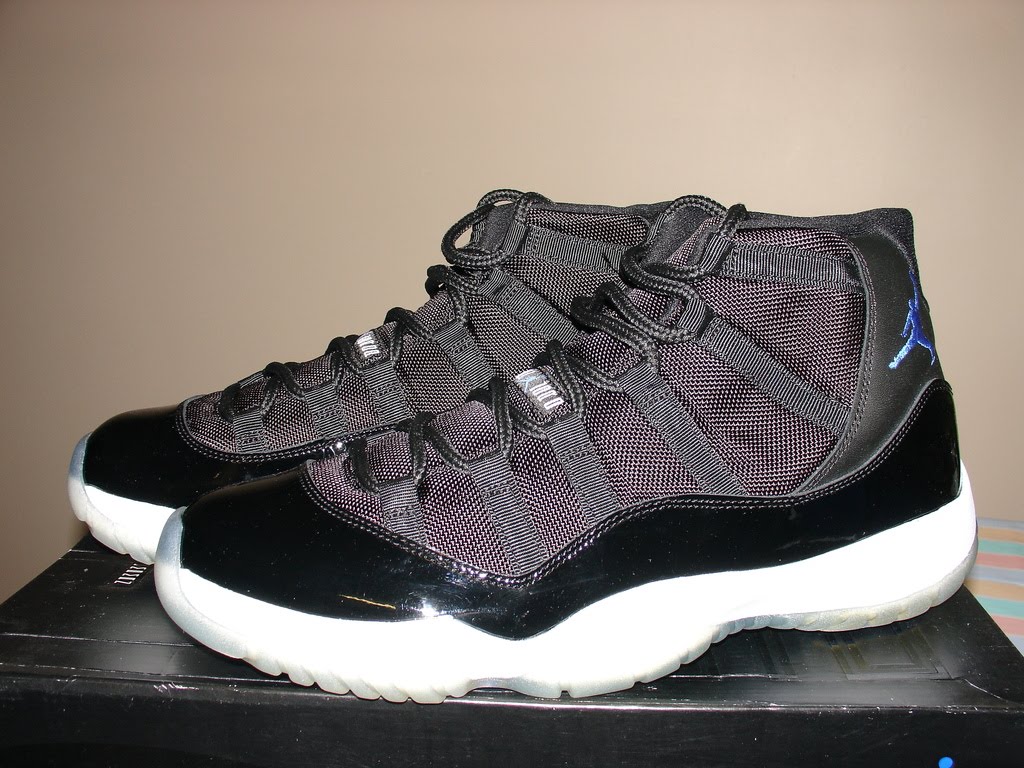

Thirty years after Space Jam, Jordan Brand is returning to a story that made a basketball shoe feel like a character in a larger world. Its anniversary collection reaches beyond a single retro: Nike describes multiple Air Jordan 11 interpretations, other Jordan silhouettes and apparel across sport and lifestyle. The scale matters because the 1996 film did not live in one lane either. It joined animation, a global basketball star, music and merchandise in the same cultural moment.
Why the XI carries the memory
The black patent-leather Air Jordan XI is the visual shortcut most people recognize. Its shiny mudguard looked unlike a conventional basketball shoe, particularly beside the black upper and translucent sole. On screen, that contrast held up under arena light and animation. Off screen, it helped make the shoe legible from across a room. The design is strong enough to survive repeated retros; the emotional charge comes from where people first met it.
Jordan Brand’s anniversary announcement points back to the face box associated with the 2000 release. Packaging is not a throwaway detail for a collector. It is part of the ritual of opening a pair and part of the visual record people remember. Recreating it says that the brand understands the release as an object with its own history, not simply a familiar color applied to current inventory.
What the new collection actually covers
The official lineup names five Air Jordan 11 designs, Jordan First 1 “Space Jam,†an Air Jordan 3 Retro, an Air Jordan 1 Low SE “Magic Ball†and an Air Jordan 1 Low Golf Spike, plus apparel for adults and children. That is a wider program than one faithful XI reissue. Readers looking for a particular pair should check Jordan Brand’s product pages for the exact colorway, size run and release date; an anniversary announcement is not proof that every item is available at the same time or in every region.
This breadth creates an interesting test. A recognizable franchise can make a product instantly visible, but it can also flatten the design into a logo exercise. The strongest pieces will carry a detail that still works for someone who has not seen the film. A first-time buyer might care about shape, material or comfort before nostalgia. A longtime fan may judge whether the finish and proportions recall the pair they remember. Those are different audiences, and neither should be treated as an afterthought.
The soundtrack lesson for product storytelling
A film memory rarely belongs to one image. People recall what played in the car, who watched with them, and the first time they noticed Jordan’s shoes. That is why this release is a useful case study for independent artists. A project cover, visualizer, performance clip and physical item should make sense together, but they do not need to repeat the same image. Each can add a piece of the world.
The anniversary campaign will be most convincing when it connects old fans’ specific memories to a reason for new audiences to care now. Nostalgia cannot do all of that work alone. It can open the door; the product and the story still have to stand once the old photograph is put away.
Source and scope: Collection details come from Jordan Brand’s 2026 announcement. The cultural and creative analysis is WilderBeatz commentary. This article does not claim firsthand product testing.